Don't outsource the judgment that makes you valuable.
Six human skills that grow more valuable as AI makes execution easier + a practical way to keep your thinking in the loop.
Every other week: one skill, one practical shift, one prompt worth keeping.
Distilled by Lyndon Cerejo from two decades in the gap between what tools can do and what people actually need
The danger isn't AI. It's dependency.
AI writes the emails, generates the designs, and drafts the strategy decks. What used to set people apart is becoming baseline. The real failure mode is quieter: polished output masking weak thinking. Call it synthetic competence.
The edge isn't moving toward people who adopt faster. It's moving toward people who can still do what the tools cannot.The goal is not to keep AI out of the work. It is to keep yourself in the practice.
- Decide which problem is actually worth solving before the model answers the wrong one beautifully
- Sense what matters beneath the data the dashboard flattened out
- Push back when the confident-sounding output is strategically wrong
- Direct people, tools, and trade-offs toward a shared outcome
- Give an emerging intention deliberate form, not polish that only looks finished
Six skills. Three domains.
These are not personality traits. They are practices that can be learned, sharpened, and applied across disciplines. AI can support each one. The responsibility for practicing and owning them remains human.
Curiosity
Curiosity is typing a different question when the first reply feels too clean and refusing to ship until you understand the anomaly everyone else accepted.
Critical Judgment
Critical judgment is how you turn a polished AI draft into a decision you can defend and how you spot what's statistically significant and strategically wrong.
Empathy
Empathy is hearing what someone means, not what they typed and catching the real feedback in the one-line comment the sentiment model smoothed over.
Advocacy
Advocacy protects the people, values, and consequences that don't show up on the dashboard even when the model, the metric, and the deadline all say go.
Orchestration
Orchestration is bringing the right capabilities together and keeping them pointed in the same direction. It’s making sure that people and AI are not just producing good work, but producing work that belongs together.
Shaping
Shaping is giving an emerging intention deliberate form by choosing, arranging, testing, and revising what matters. It's moving past polishing what AI produced to making something purposeful, usable, and able to survive contact with the world.
They don't compete with AI.
They do the work AI makes more necessary.
Leaders & Managers
Better decisions, better judgment, better questions - because you know which inputs to trust and which to challenge.
Designers & Creators
Less dependence on execution, more strength in framing, taste, and advocacy - the work that can't be automated.
PMs & Strategists
Stronger translation between data, people, and action - the connector role AI can't replace.
Career Navigators
Capabilities that compound as AI improves, instead of a résumé of tasks that erodes.
Prime · Assess · Interpret · Retain
PAIR is the difference between AI developing your judgment and AI replacing it.
Prime Before You Prompt
Define the problem, stakes, constraints, and your starting point of view before AI enters the work. If you don't prime your own thinking, the tool will frame the problem for you.
Assess Before You Accept
Interrogate the logic, assumptions, evidence, gaps, tradeoffs, and consequences of what AI gives you. Ask what would make it wrong.
Interpret With Ownership
Decide what to keep, what to reject, and what you're willing to defend without rereading the AI output. A prompt is not a substitute for a point of view.
Retain Before You Repeat
Notice what you almost outsourced. Every AI use should make your judgment sharper, not softer, so the next round builds your capability instead of eroding it.
If AI did the thinking and you just did the editing, you didn't use PAIR. You got used by it.
Where this comes from
Undelegatable didn't come from a trend cycle. It grew out of years spent leading teams, shipping products, and studying what separated excellent practitioners from merely competent ones.
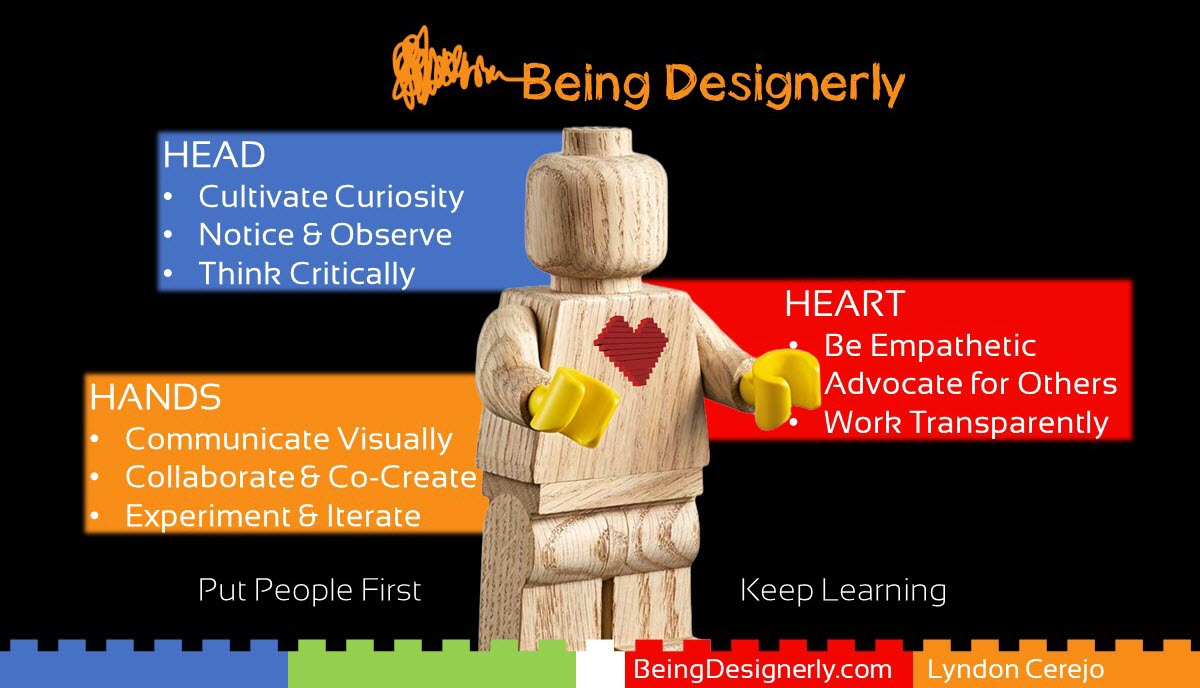
That work first took shape through Being Designerly - a philosophy and newsletter exploring the human skills designers practice when working through ambiguity, complexity, and real-world constraints.
Over time, a broader pattern emerged: these skills weren't just for designers. They were the same capabilities that made leaders, strategists, and creators effective across disciplines.
Then AI changed the equation. As tools grew more capable, execution got cheaper and output became abundant. The premium didn't move toward people who adopted faster - it moved toward people who could do what the tools couldn't. The six skills in this framework are the ones that become more necessary as AI takes on more.
PAIR is how you practice them in daily AI work - so the tools make your judgment sharper, not softer.
Undelegatable is the public expression of that insight.
Read the origin story
Lyndon Cerejo
I’ve spent my career in the gap between what tools can do and what people actually need — leading design teams, shaping digital platforms, and studying why some practitioners thrive in complexity while others stall.
Undelegatable is the framework I wish I’d had earlier. It names the skills I’ve seen matter most — not just in design, but in every role where ambiguity is the norm and AI is changing what’s expected.
Build your undelegatable edge
What Makes You Undelegatable?
A 5-minute diagnostic to reveal the human strength AI still struggles to fake - and the one you should sharpen next.
Find your archetypeThe Book
Undelegatable: the six human skills that keep people valuable when output is abundant and thinking is easy to outsource. Research, practitioner stories, and practices you can put to work.
Follow the progress